1 June 2026
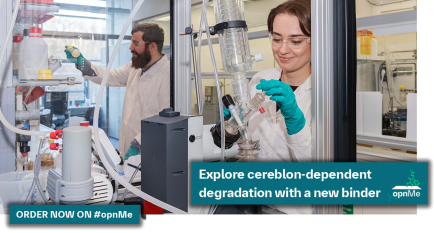
Understanding and modulating cereblon (CRBN) function is central to advancing targeted protein degradation strategies. To support research in this evolving field, Boehringer Ingelheim is making BI‑3757, a novel CRBN binder, available through opnMe.
BI‑3757 is a unique CRBN ligand that binds to the orthosteric tri‑tryptophan pocket within the thalidomide‑binding domain yet stabilizes CRBN in its open, degradation‑incompetent conformation. In contrast to classical thalidomide‑derived ligands that promote CRBN closure and neosubstrate ubiquitination, BI‑3757 enables selective interrogation of CRBN biology independently of induced protein degradation.
As such, BI‑3757 serves as a valuable chemical tool to explore structural and functional aspects of open versus closed CRBN conformations and to study the consequences of CRBN inhibition without confounding neosubstrate effects.
Developed through a collaboration between the University of Dundee and Boehringer Ingelheim, BI‑3757 is complemented by a structurally related negative control (BI‑4506), supporting robust experimental design and interpretation.
No registration required
Subscribe to our newsletter to stay updated as we add new molecules to opnMe.com.
About BI-3757:
BI‑3757 shows robust biophysical binding to cereblon (CRBN), as demonstrated by surface plasmon resonance, and engages CRBN in cells as assessed by NanoBRET. The compound is suitable as an in vitro chemical tool to study the biological and structural consequences of open versus closed CRBN conformations. Due to low hepatic stability in rodents, BI‑3757 is not recommended for in vivo applications. Broad off‑target profiling highlighted the good selectivity of BI‑3757 and the structurally related negative control BI‑4506.
About opnMe:
opnMe.com, the open innovation portal of Boehringer Ingelheim, fosters science and collaboration initiatives in areas of high unmet medical need. As part of our “Molecules to Order” pillar, we share well-characterized tool compounds free of charge with no IP strings attached. With “opn2EXPERTS”, we enlist scientific advice on key biologic issues to fuel further drug discovery and deliver novel solutions that benefit unmet patient needs. Our opn2TALENTS PostDoc grants provide an opportunity for high-caliber talents to pitch their scientific approaches for well-defined research questions to conduct their research at one of our discovery research sites.