MDM2-p53 antagonist
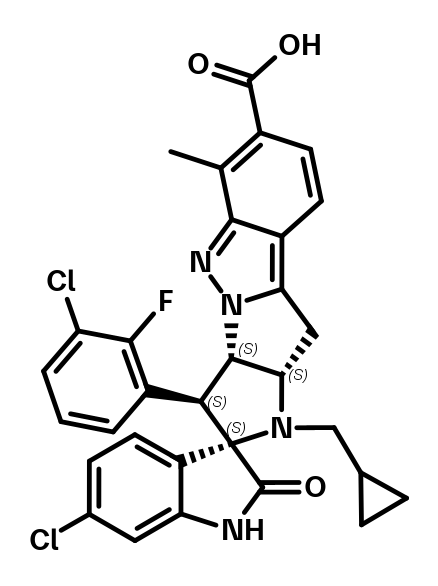
BI-7828
BI-7828 is an oral small-molecule MDM2 antagonist that activates p53 in TP53 wild-type tumors by blocking the p53-MDM2 interaction. It demonstrates good permeability, cellular potency, and in vivo activity. Clinical studies demonstrated target engagement and displayed antitumor activity. However, development was discontinued after the Phase II/III Brightline 1 trial failed to meet its primary endpoint.
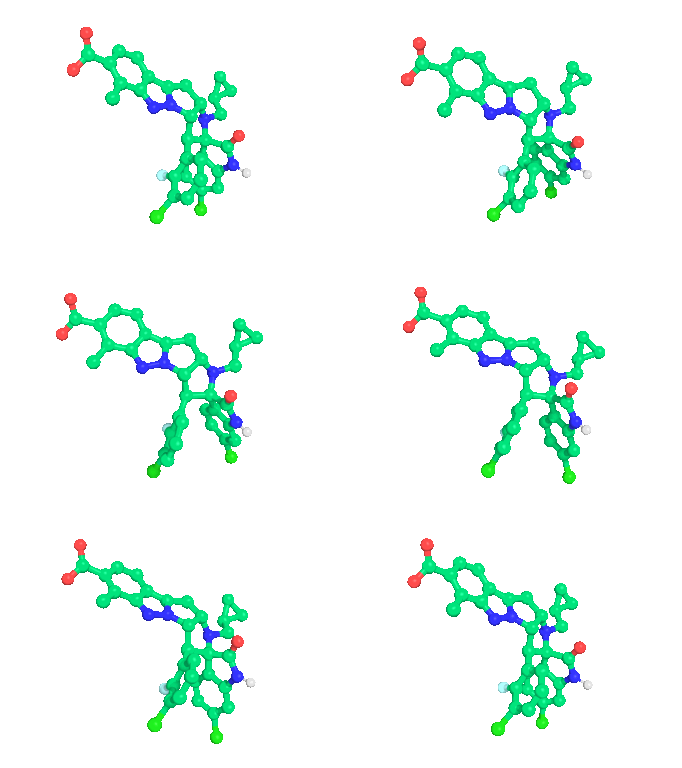


More information
p53 is a critical tumor suppressor. Acting as a transcription factor, p53 regulates numerous downstream target genes that control cell cycle arrest or senescence, trigger apoptosis or facilitate DNA repair. Under normal conditions, p53 protein levels remain low due to rapid proteasome-mediated degradation. When cells experience stress or DNA damage, p53 is swiftly activated.
In cancer, the TP53 gene encoding p53 is frequently altered. It is in fact one of the most frequently mutated genes in human cancer, with approximately 50% of tumors carrying mutations or deletions.1 In the remaining cases, p53 function is often compromised by alternative mechanisms2, such as overexpression or amplification of its primary negative regulator, MDM2. MDM2, an E3 ubiquitin ligase, controls p53 activity and stability through three key mechanisms:
- Transcriptional repression: MDM2 binds to p53’s transactivation domain, inhibiting its transcriptional activity.
- Nuclear export: MDM2 shuttles p53 from the nucleus to the cytoplasm.
- Protein degradation: MDM2’s E3 ligase activity promotes proteasome-mediated degradation of p53.3
BI-7828 is a small-molecule antagonist that blocks the interaction between MDM2 and p53, thereby restoring p53´s tumor suppressor activity in tumors with wild-type p534. The phase II/III Brightline-1 trial that assessed BI-7828 versus doxorubicin as first line treatment for MDM2-amplified, locally advanced/metastatic dedifferentiated liposarcoma (DDLPS) failed its primary endpoint and further clinical development was discontinued.5 BI-7828 complements the MDM2-p53 antagonist BI-0282 that is also available on opnMe.6
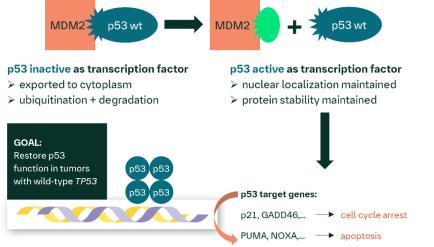
Mechanism of action of BI-7828, a small-molecule that blocks the interaction of p53 with its negative regulator MDM2.
BI-7828 exhibits single-digit nanomolar biochemical potency (IC50 = 2 nM) in an ALPHASCREEN assay, which measures the interaction of human MDM2 with a human p53-derived peptide.
Cellular potency was assessed in an MDM2-amplified, TP53 wild-type cancer cell line. Single-digit nanomolar cellular potency was demonstrated (SJSA-1; IC50 = 12 nM).
| Probe name / Negative control | BI-7828 | BI-8965 |
| MW [Da]a | 591.46 | 591.46 |
| MDM2::p53 AlphaScreen assay (IC50) [nM]b | 2 | 2,471 |
| Celluar potency SJSA-1 (IC50) [nM]c | 12 | 13,109 |
aThe molecule is supplied in salt form; for the molecular weight of the salt, please refer to the vial label.
bAssay conditions: AlphaScreen biochemical assay: This assay was developed to identify compounds which interfere with the p53-MDM2 interaction and thus restore p53 function. For profiling, compounds are diluted to a final start concentration of 25 µM followed by 10 subsequent 1:5 dilution steps. Compounds are tested in duplicates. The assay is run on a fully automated robotic system in a darkened room below 100 Lux. To 5 µl of compound dilution (final dilution in the assay 1:400, final DMSO concentration 5%) 5 µl of MDM2/p53 peptide mix are added into columns 1-23, 5 µl of assay buffer into column 24. After an incubation time of 15 minutes at room temperature 5 µl of bead mix is added. Plates are kept at room temperature in a darkened incubator.
After a 30-minute incubation time, the signal is measured in a PerkinElmer Envision HTS Multilabel Reader using the AlphaScreen specs from PerkinElmer. Each plate contains 16 wells of a negative control (diluted DMSO instead of test compound; w protein peptide mix; column 23) and 16 wells of a positive control (diluted DMSO instead of test compound; w/o protein peptide mix; column 24). As an internal control, a known antagonist of the MDM2/p53 interaction is used in the same compound dilution scheme. IC50 values are calculated and analyzed in the MEGASTTAR IC50 application using a 4 parametric logistic model.
cAssay conditions: CellTiter Glow-based cytotoxicity assay: 2000 SJSA-1 cells are seeded in 180 µl RPMI + 10% FCS + Penstrep into a 96-well flat bottom plate. The plates are incubated at 37 °C in a CO2 incubator overnight. The compounds are diluted to the appropriate start concentration between 10 and 100 µM. The cells are incubated with the compounds for 3 days. Then, 30 µl of CellTiter Glow is added to each well, it is agitated for 30 minutes, and the luminescence is measured. IC50 values are calculated using the Smiley program (based on GrapPad Prism) or the MEGASTAR IC50 Application.
BI-7828 is a small molecule, with high lipophilicity and low aqueous solubility. It shows excellent stability in liver microsomes and hepatocytes and is highly bound to plasma proteins.
The absorptive permeability of BI-7828 is good with a low efflux ratio of 1.3, as determined in the Caco2-assay.
No relevant inhibition of the hERG channel and CYP3A4 was observed by subjecting BI-7828 to the according assays.
| Probe name / Negative control | BI-7828 | BI-8965 |
| logD @ pH 7.4 / logP @ pH 2.0 | 2.8/6.1 | n.d. |
| Solubility @ pH 6.8 [mg/ml] | 0.090 | 0.092 |
| Caco-2 permeability @ pH 7.4 [*10-6 cm/s] | 84 | n.d. |
| Caco-2 efflux ratio | 1.3 | n.d. |
| Microsomal stability (human/mouse/rat) [% QH] | <24 / <24/ <24 | 40 / n.d. / 45 |
| Hepatocyte stability (human/mouse/rat) [% QH] | <11/<15/5 | n.d. |
| Plasma Protein Binding (human/mouse/rat) [%] | >99.8/>99.9/>99.9 | n.d. |
| hERG [inh. % @ 10 µM] | 17% | n.d. |
| CYP 3A4 Mid/Tes/Nif (IC50) [µM] | 36/>50/>50 | n.d. |
| CYP 2C8 (IC50) [µM] | 2.1 | n.d. |
| CYP 2C9 (IC50) [µM] | 27 | n.d. |
| CYP 2C19 (IC50) [µM] | >50 | n.d. |
| CYP 2D6 (IC50) [µM] | >50 | n.d. |
| CYP 2B6 (IC50) [µM] | 35 | n.d. |
| CYP 1A2 (IC50) [µM] | >50 | n.d. |
Low clearance, high oral bioavailability and dose linearity with low variability in AUC and Cmax were observed across different preclinical species for BI-7828.1
| BI-7828 | Mouse | Rat |
| Clearance [% QH] | 1.5 a | 0.73 a |
| Mean residence time after i.v. dose [h] | 5.5 a | 9.6 a |
| tmax [h] | 4.7 b | 1.3 c |
| Cmax [nM] | 74,000 b | 57,000 c |
| Vss [l/kg] | 0.44 a | 0.28 a |
| F [%] | 119 | 55 |
a i.v. dose 5 mg/kg
b p.o. dose 5 mg/kg
c p.o. dose 2 mg/kg
BI-7828 restored p53 activity and led to apoptosis induction in preclinical models of TP53 wild-type MDM2-amplified cancer. Oral administration of BI-7828 in an intermittent dosing schedule induced potent tumor growth inhibition in several TP53 wild-type, MDM2-amplified xenograft models. Efficacy of BI-7828 was assessed in an MDM2-amplified, p53 wild-type human osteosarcoma xenograft model (SJSA-1) in immune-deficient mice.1 Two oral dose schedules were tested. Mice received either a single-dose of BI-7828 (1, 1.5 or 2 mg/kg) on day 1 and day 8 or they received a split-dose (1 mg/kg + 1 mg/kg, Δ 7h) on day 1 and 8, with the control group receiving a split-dose of vehicle. The single-dose regimens showed a clear dose-response relationship. The split-dose group (1 mg/kg + 1 mg/kg, Δ 7h) had a less pronounced and shorter antitumor effect than the corresponding single-dose group of 2 mg/kg. These data demonstrate that treatment with BI-7828 leads to durable antitumor activity with single doses administered 1 week apart (Figure 4). Extending this analysis, BI-7828 demonstrated antitumor activity in several MDM2-amplified, TP53 wild-type patient-derived xenograft (PDX) models1 (data not shown).
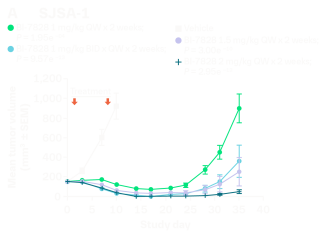
Efficacy of BI-7828 in a SJSA-1 xenograft model after oral dosing, administering a single oral dose (1, 1.5, 2 mg/kg) on day 1 and day 8 or a split dose (1 mg/kg + 1 mg/kg, Δ 7h) on day 1 and day 8.
A dose-dependent increase of GDF15 protein levels, a biomarker of p53 target engagement could be detected in serum samples form SJSA-1 tumor bearing mice 24 hours after a single oral dose of BI-7828 (0.25, 0.75, 2 or 10 mg/kg) (Figure 5A). The increase of GDF15 in serum was positively correlated to the degree of GDF15 mRNA induction observed in tumor samples (Figure 5 B+C). This data set supported the use of plasma GDF15 levels as a biomarker of target engagement in patients.
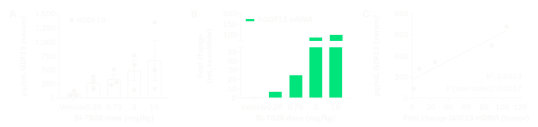
Modulation of GDF15 protein levels in serum (A) and GDF15 mRNA induction in tumor samples (B) in SJSA-1 tumor bearing mice, 24 h after a single oral dose of 0.25, 0.75, 2 or 10 mg/kg. (C) Correlation between GDF15 protein levels in serum with GDF15 mRNA induction in tumor samples.
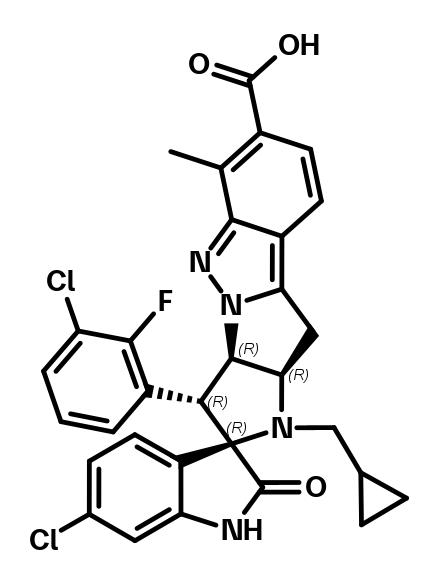
BI-8965 is the distomer of BI-7828, exhibiting a 1200-fold reduction in potency compared to its eutomer. The negative control compound has not been assessed in animal studies.
BI-8965, which serves as a negative control
The selectivity of BI-7828 was assessed in the SafetyScreen44™ at a concentration of 10 µM to assess off-target interaction with GPCR receptors, nuclear hormone receptors, transporters and ion channels. Although BI-7828 showed binding to hERG with 73% inhibition of the binding of a radioactively labelled ligand (dofetilide) in this panel, additional functional assays showed no inhibition of hERG activity at a concentration of 10 µM and even no inhibition at a concentration of 100 µM when tested in the presence of 80% plasma.
BI-7828 was further tested in a kinase panel of 31 kinases from Invitrogen®. BI-7828 did not inhibit any of these kinases at a concentration of 10 µM.
| SELECTIVITY DATA AVAILABLE | BI-7828 | BI-8965 |
SafetyScreen44™ with kind support of  | Yes | No |
| Invitrogen® | Yes | No |
| DiscoverX® | No | No |
| Dundee | No | No |
Download selectivity data:
BI-7828_selectivitydata.xlsx
The X-ray crystal structure of target in complex with BI-7828 is available (PDB code: 8PWC).1
Other available tool compounds: BI-0282
Discovery and Characterization of BI-7828, a Novel and Highly Potent MDM2–p53 Antagonist Suitable for Intermittent Dose Schedules
Gollner A., Rudolph D., Weyer-Czernilofsky U., Baumgartinger R., Jung P., Weinstabl H., Ramharter J., Grempler R., Quant J., Rinnenthal J., Pérez Pitarch A., Golubovic B., Gerlach D., Bader G., Wetzel K., Otto S., Mandl C., Boehmelt G., McConnell D. B., Kraut N., Sini P.
Mol Cancer Ther. 2024, 23(12), 1689-1702.
Brigimadlin versus Doxorubicin in Advanced Dedifferentiated Liposarcoma: Efficacy, Safety, and Translational Data from Brightline-1, a Randomized Phase II/III Trial
Schöffski, P., Sanfilippo, R., Martín-Broto, J., Kawai, A., Desai, J., LoRusso, P., Maki, R. G., Jones, R. L., Blay, J.-Y., Smrke, A., Razak, A. A., Italiano, A., Sebio, A., Bahleda, R., Lee, Y. C., Graaf, W. T. A. van der, Zhang, X., Biyukov, T., Teufel, M., Fu, E., Wagner, A. J.
Clinical Cancer Research 2026, OF1–OF14.
When you plan a publication, please use the following acknowledgement:
BI-7828 was kindly provided by Boehringer Ingelheim via its open innovation platform opnMe, available at https://www.opnme.com.