pan-KRAS(on) PROTAC
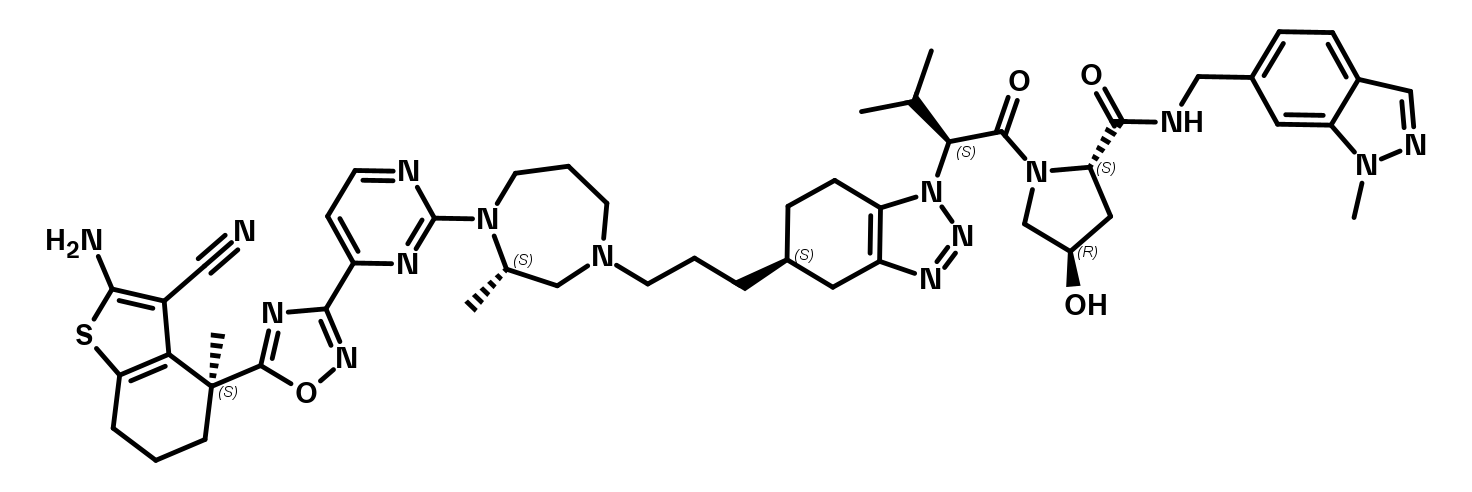
ACBI4
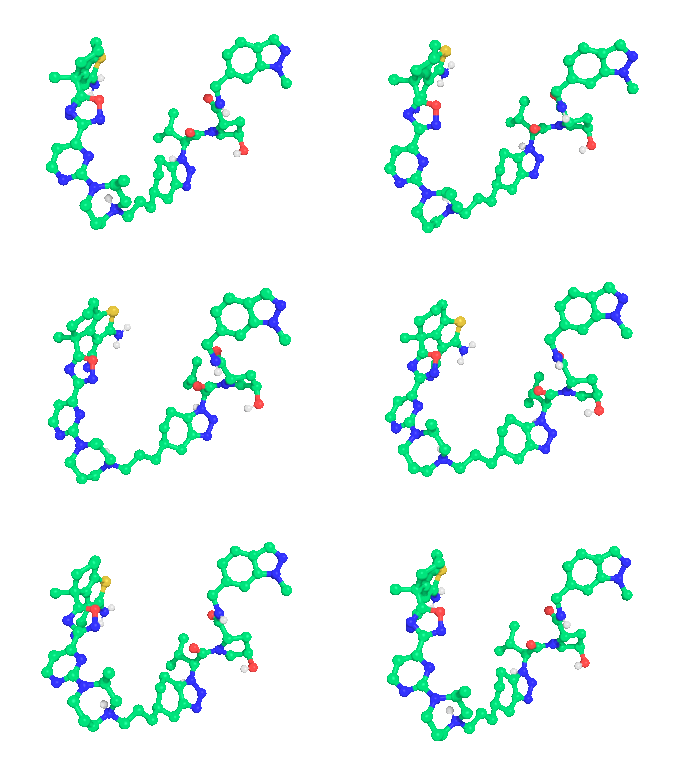
ACBI4 is a highly cooperative, potent PROTAC degrader, developed through a collaboration between Boehringer Ingelheim and the Centre for Targeted Protein Degradation at the University of Dundee, that targets GTP‑loaded (active) KRAS mutants, including challenging alleles such as G12R. ACBI4 forms exceptionally stable ternary complexes, achieves rapid and profound KRAS degradation, and induces strong antiproliferative effects in KRAS‑driven cancer cells in vitro.


More information
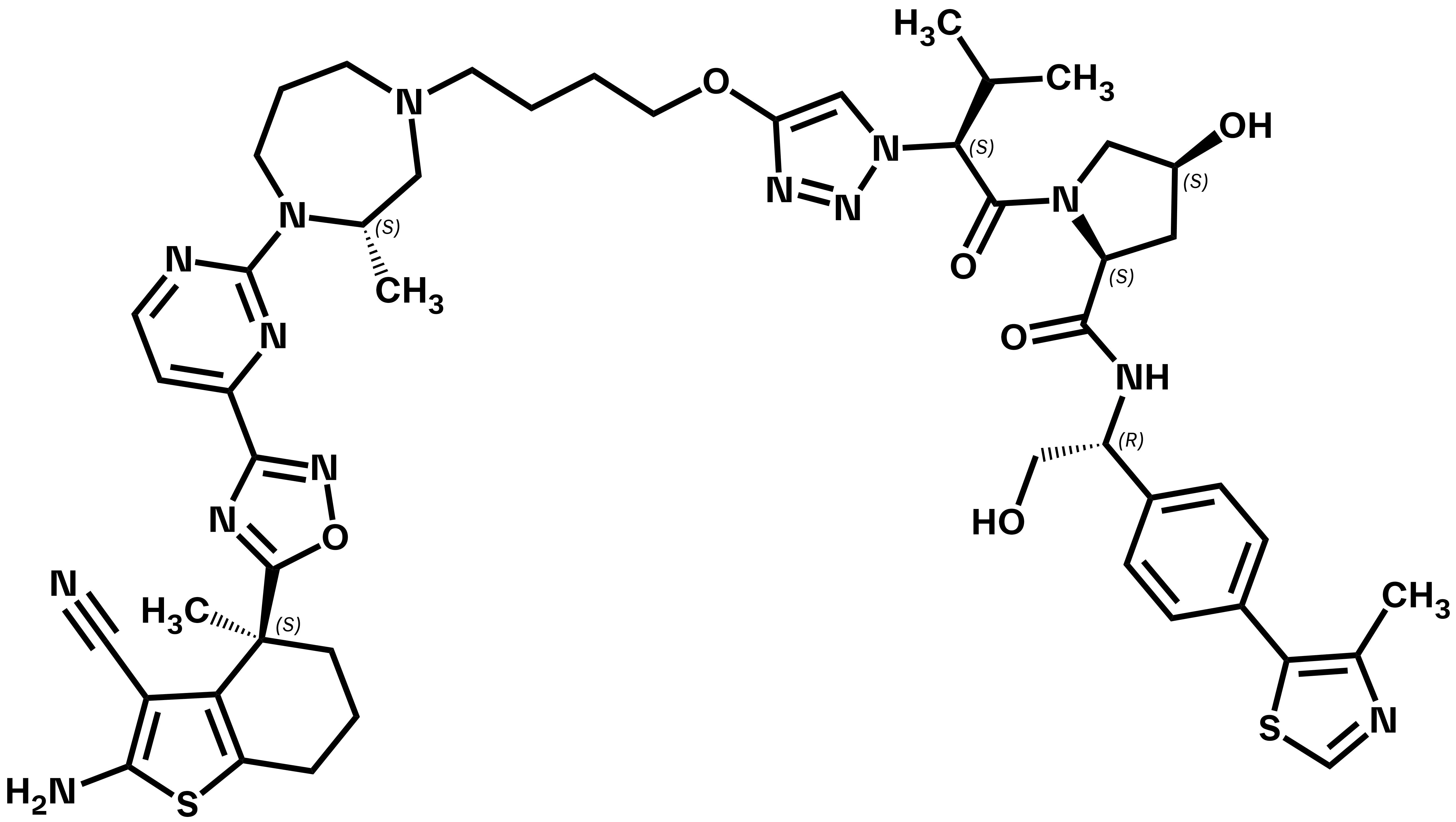
Kirsten rat sarcoma viral oncogene homologue (KRAS) is the most commonly mutated oncogene in human cancers. Variants, predominantly mutations at Glycine (G) 12 or Glutamine (Q) 61, increase the proportion of activated, GTP-loaded KRAS, enhancing RAF-MEK-ERK (MAPK) signalling, and drive tumor growth3. Developed in collaboration with Centre for Targeted Protein Degradation, University of Dundee, ACBI4 is a first in class proteolysis targeting chimera (PROTAC) potently degrading 14 out of 17 of the most prevalent oncogenic KRAS variants including KRAS(on) variants. ACBI4 is poorly soluble and lacks oral bioavailability. As a negative control, cis-ACBI3, is available that contains the same KRAS binding moiety.
Due to its exceptionally high cooperativity ACBI4 effectively engages the GTP activated state of KRAS, to drive rapid and profound degradation of KRAS(on) mutants, leading to antiproliferative effect in a cell line driven by KRASG12R.1
ACBI3, a widely adopted pan-KRAS degrader available via opnMe, is complemented by ACBI4 (pan-KRAS(on) PROTAC). ACBI3 primarily targets the inactive (GDP-bound) form of KRAS and enables broad mutant degradation, whereas ACBI4 selectively engages the active (GTP-bound) state, addressing KRAS(on) variants that are less accessible to off-state degraders. Together, they provide complementary tools to explore KRAS biology across signaling states and degradation mechanisms.
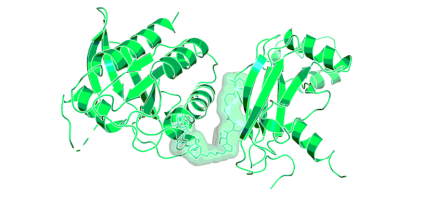
X-ray structure of the complex of ACBI4 with KRAS and VHL (PDB code 9RKE)1.
ACBI4 exhibits potent intracellular VHL engagement, ternary complex formation, and ubiquitination translating into efficient E3-ligase dependent cellular degradation and proteome-wide selectivity. ACBI4 displays antiproliferative activity in a cell line panel on KRAS mutant but not KRASWT cell lines (geometric mean IC50 = 478 nM vs 8.3 µM, respectively).
| Probe name / Negative control | ACBI4 | cis-ACBI3 |
| MW [Da]a | 970.22 | 1,019.25 |
| Cellular KRASG12D degradation, 18 h (GP5d cells) (DC50) [nM]b | 7 | > 1,000 |
| Cellular KRASG12R degradation, 18 h (KP-2 cells) (DC50) [nM]b | 151 | n.d. |
| Cellular proliferation, 3 days (KP-2 cells) (IC50) [nM]c | 174 | n.d. |
aPlease note that ACBI4 and cis-ACBI3 are supplied in salt form; for the molecular weight of the salt, please refer to the vial label
bby capillary electrophoresis using the following antibodies: KRASG12D (Cell Signaling #14429), KRASG12V (Cell Signaling #14412), normalized by GAPDH (Abcam #ab9485),
cby CellTiterGlo assay (Promega #G7570)
ACBI4 is a large, lipophilic molecule that exhibits moderate aqueous solubility at physiological pH (6.8), which is improved relative to the negative control cis‑ACBI3. It has low stability in liver microsomes while being good to moderately stable in hepatocytes. Despite its size and lipophilicity, ACBI4 demonstrates good apparent permeability in Caco‑2 assays, with a measured efflux ratio of 2.6, indicating some transporter‑mediated efflux but overall favorable absorptive properties.
| Probe name / Negative control | ACBI4 | cis-ACBI3 |
| logD @7.4 | 3.8 | 4.3 |
| Solubility @ pH 6.8 [µg/ml] | 15 | <1 |
| Caco-2 permeability @ pH 7.4 [*10-6 cm/s] | 9.3 | n.d. |
| Caco-2 efflux ratio | 2.6 | n.d. |
| Microsomal stability (human/mouse/rat) [% QH] | >88/70/>88 | >88/>88/75 |
| Hepatocyte stability (human/mouse/rat) [% QH] | 85/72/34 | n.d. |
cis-ACBI3, which serves as a negative control.
The degradation selectivity of ACBI4 was assessed by whole cell proteomics MS analysis of Cal-62 cells treated for 6 hours with 1 µM ACBI4 or a negative control. The below figure validates selective degradation of KRAS. Interestingly, NRAS degradation was observed only at very high concentrations of ACBI4, indicating a degree of selectivity for KRAS over NRAS. Additionally, HRAS degradation was noted at higher concentrations of ACBI4, with maximal degradation achieved at 3 µM (DC50 = 637 nM, Dmax = 72%). This represents a roughly 2-fold selectivity window over KRAS degradation (DC50 = 382 nM, Dmax = 88%). These findings suggest that ACBI4 exhibits preferential degradation of KRAS while sparing NRAS and HRAS at lower concentrations, which could be advantageous in maintaining a therapeutic window.
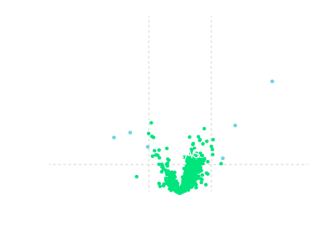
Volcano plot of whole cell proteomics MS analysis of Cal-62 cells treated with 1 µM ACBI4 or negative control (6 hours).
Download selectivity data:
cis-ACBI3_selectivityData
Selectivity data for ACBI4 are in preparation and will be added soon.
The X-ray crystal structure of target in complex with ACBI4 is available (PDB code: 9RKC and 9RKN)1.
Other available tool compounds: ACBI32 which is also available to order via opnMe.
Identification of a Highly Cooperative PROTAC Degrader Targeting GTP-Loaded KRAS(On) Alleles
Vetma V., Puoti I., Karolak N. K., Chakraborti S., Diers E., Girardi E., Khan S., Kidd G., Kropatsch K. G., McLennan R., O'Connor S., Samwer M., Trainor N., Whitworth C., Wijaya A. J., Wong J. Y. F., Zollman D., Farnaby W., Popow J., Ciulli A., Ettmayer P., McAulay K.
Journal of the American Chemical Society 2025, 147(45), 41367–41378.
Targeting cancer with small molecule pan-KRAS degraders
Popow J., Farnaby W., Gollner A., Kofink C., Fischer G., Wurm M., Zollman D., Wijaya A., Mischerikow N., Hasenoehrl C., Prokofeva P., Arnhof H., Arce-Solano S., Bell S., Boeck G., Diers E., Frost A.B., Goodwin-Tindall J., Karolyi-Oezguer J., Khan S., Klawatsch T., Koegl M., Kousek R., Kratochvil B., Kropatsch K., Lauber A.A., McLennan R., Olt S., Peter D., Petermann O., Roessler V., Stolt-Bergner P., Strack P., Strauss E., Trainor N., Vetma V., Whitworth C., Zhong S., Quant J., Weinstabl H., Kuster B., Ettmayer P., Ciulli A.
Science 2024, 385(6715), 1338-1347.
When you plan a publication, please use the following acknowledgement:
ACBI4 was kindly provided by Boehringer Ingelheim via its open innovation platform opnMe, available at https://www.opnme.com.