GPR55 inverse agonist
BI-8310
BI-8310 is a potent and efficacious GPR55 inverse agonist with favorable physicochemical properties and an in vitro DMPK profile supporting its use as a robust tool compound. It exhibits inverse agonist activity against the constitutive activity of GPR55 and is also active in assays using the endogenous ligand LPI. A cryo-EM structure of GPR55 in complex with the active (S)-enantiomer of BI-8310 is available, enabling structure-based investigations. The structurally related compound BI-6227 serves as a negative control.
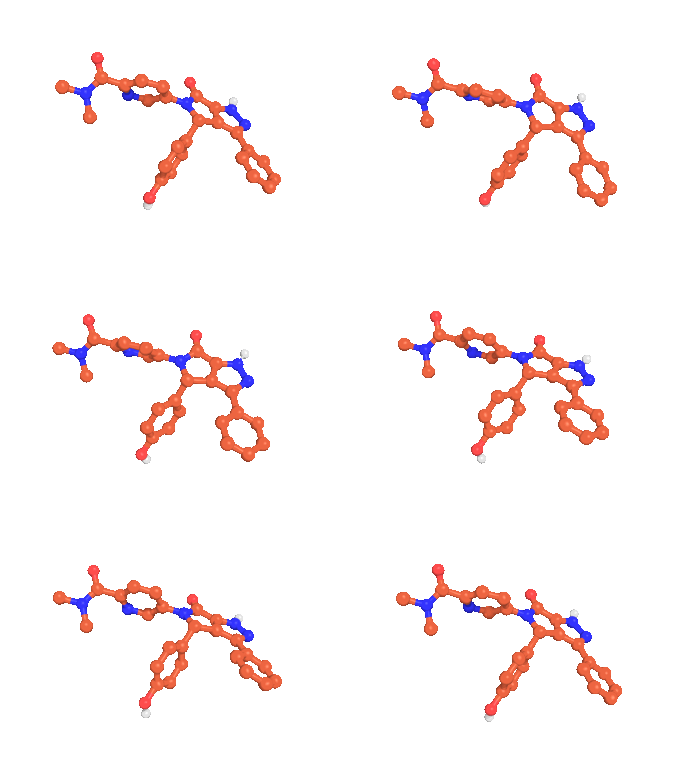


More information
GPR55 is a lipid-activated G protein-coupled receptor (GPCR) whose pharmacological characterization has been hindered by the limited availability of suitable tool compounds 1-3. Lysophosphatidylinositol (LPI) is considered its most likely endogenous ligand, although definitive in vivo evidence is still lacking. As a result, GPR55 has not yet been fully deorphanized4. Unlike many classical GPCRs activated by neurotransmitters or hormones, GPR55 is modulated by bioactive lipids and certain cannabinoid-related compounds5. However, its classification as a cannabinoid receptor remains controversial due to inconsistent pharmacological profiles6.
GPR55 signalling predominantly engages Gα13 and downstream pathways such as RhoA (Ras homolog family member A) and Rho-associated kinases (ROCK), influencing cytoskeletal dynamics, calcium mobilization and cellular motility7,8. Notably, GPR55 exhibits high constitutive activity via Gα13 signalling9 and is widely expressed in the central nervous system, gastrointestinal tract, liver, adrenal glands, and immune cells. This distribution suggests roles in diverse physiological processes including energy metabolism, inflammation, and immune regulation 7.
Recent cryo-electron microscopy (cryo-EM) studies9 have resolved GPR55 in complex with different ligands, revealing key structural features such as N-linked glycosylation near the ligand binding pocket as well as a cholesterol binding pocket directly contacting ligands. These insights provide a foundation for rational, structure-based ligand design.
Despite growing interest in GPR55 as a target for mechanistic and drug discovery research, significant challenges persist. These include limited availability of selective tool compounds, incomplete understanding of its in vivo functions, and the complexity of its lipid-mediated signalling9,10,11. Addressing these gaps may support further investigation of GPR55 biology and pharmacology.
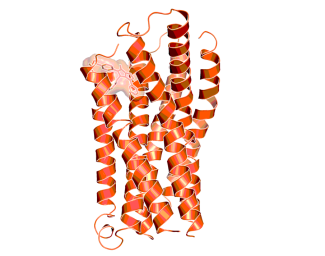
Bound conformation of the active BI-8310 enantiomer, as observed in complex with GPR55 (Boehringer in house cryo-EM structure)
BI-8310 exhibits potent inverse agonist activity with an IC50 value of 263 nM and an efficacy (Emax) of -53% in a bioluminescence energy transfer (BRET)-based G13 protein dissociation assay targeting constitutive receptor activation. BI-8310 shows a ~3-fold reduction in potency when tested against the 80% effective concentration (EC80) of LPI. In contrast, the structurally related compound BI-6227, is inactive at concentrations up to 100 µM. In a β-arrestin2 recruitment assay (PathHunter), BI-8310 showed a potency of 610 nM against the EC80 of LPI. The S-enantiomer of BI-8310 represents the eutomer. However, BI-8310 is provided as the racemate because its pure enantiomers rapidly racemize in aqueous solution.
| Probe name / Negative control | BI-8310 | BI-6227 |
| MW [Da]a | 439.5 | 425.4 |
| Evaluated versus constitutive activity, BRET-based G13 protein dissociation assay (TRUPATH)3 (IC50) [nM] | 263 | >100,000 |
| Evaluated versus constitutive activity, BRET-based G13 protein dissociation assay (TRUPATH)3 (Emax) | -53% | - |
| Evaluated versus EC80 of LPI, BRET-based G13 protein dissociation assay (TRUPATH)3 (IC50) [nM] | 871 | >100,000 |
| Evaluated versus EC80 of LPI, β-arrestin2 recruitment assay (PathHunter)3 (IC50) [nM] | 610 | >10,000 |
a For the salt form you will get, please refer to the label on the vial and for the molecular weight of the salt, please refer to the FAQs.
BI-8310 exhibits a favorable in vitro DMPK profile with adequate solubility, good metabolic stability, and no relevant CYP inhibition, supporting its use as a robust in vitro tool compound despite its low membrane permeability.
| Probe name / Negative control | BI-8310 | BI-6227 |
| clogD @ pH 7.4 | 2.0 | 1.8 |
| Solubility @ pH 7 [µg/mL] | 17 | >92 |
| Caco-2 permeability AB @ pH 7.4 [*10-6 cm/s] | <0.4 | <0.5 |
| PAMPA @pH 7.4 [*10-6 cm/s] | 0.007 | 0.006 |
| Microsomal stability (human/mouse) [% QH] | 37 / <23 | 65 / <23 |
| CYP 3A4 (IC50) [µM] | >50 | >50 |
| CYP 2C8 (IC50) [µM] | >50 | 42 |
| CYP 2C9 (IC50) [µM] | >50 | 3.4 |
| CYP 2C19 (IC50) [µM] | >50 | >50 |
| CYP 2D6 (IC50) [µM] | >50 | >50 |
| CYP 1A2 (IC50) [µM] | >50 | >50 |
| CYP 2B6 (IC50) [µM] | >50 | >50 |
BI-6227, a structurally close analog, can be used as negative control.

BI-6227 which serves as a negative control
In the SafetyScreen44™ panel, BI-8310 showed >50% inhibition at 10 µM for 2 of 44 tested targets: human 5-HT2B and adenosine A2A receptors.
BI-6227 inhibited 1 out of 44 tested targets with > 50% at10 µM concentration (DELTA2/H) tested in SafetyScreen44™.
| SELECTIVITY DATA AVAILABLE | BI-8310 | BI-8310 |
SafetyScreen44™ with kind support of  | Yes | Yes |
Download selectivity data:
BI-8310_selectivitydata.xlsx
BI-6227_selectivitydata.xlsx
Other available tool compounds are CID160200461,2 and ML19312,13.
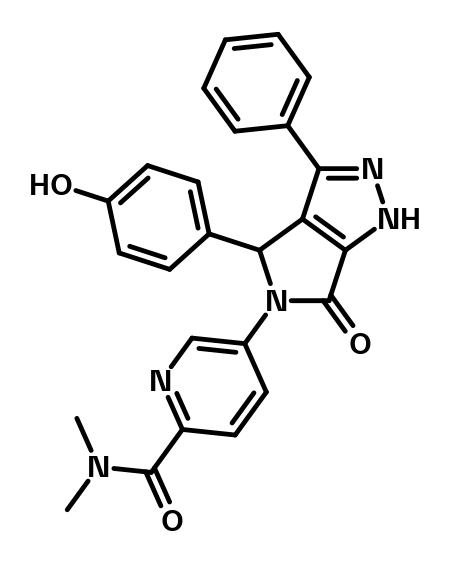
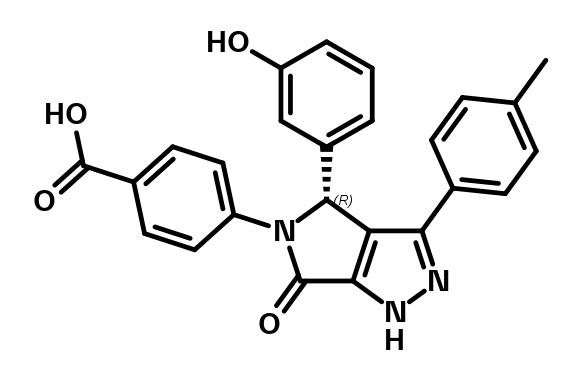
Image-Based HTS for Selective Antagonists for GPR55
National Center for Biotechnology Information 2026.
Molecular insights into GPR55 modulation reveal an atypical activation mechanism and glycosylation-dependent efficacy regulation
Claff T., Demalgiriya-Gamage C., Mahardhika A. B., Stamos N. A., Bangnowski F., Sun X., Dürr K. L., Robinson C. V., Haney R., Frego L., Nar H., Müller C. E., Ebenhoch R., Kley J. T., Weichert D.
Nat Commun. 2026, 17(1):11079.
Screening for Selective Ligands for GPR55 - Antagonists
Heynen-Genel S., Dahl R., Shi S., Milan L., Hariharan S., Sergienko E., Hedrick M., Dad S., Stonich D., Su Y., Vicchiarelli M., Mangravita-Novo A., Smith L. H., Chung T. D. Y., Sharir H., Caron M. G., Barak L. S., Abood M. E.
Probe Reports from the NIH Molecular Libraries Program [Internet] 2010 Oct 30 [Updated 2011 May 26].
Identification of the GPR55 antagonist binding site using a novel set of high-potency GPR55 selective ligands
Kotsikorou E., Sharir H., Shore D. M., Hurst D. P., Lynch D. L., Madrigal K. E., Heynen-Genel S., Milan L. B., Chung T. D. Y., Seltzman H. H., Bai Y., Caron M. G., Barak L. S., Croatt M. P., Abood M. E., Reggio P. H.
Biochemistry 2013, 52(52), 9456–9469.
When you plan a publication, please use the following acknowledgement:
BI-8310 was kindly provided by Boehringer Ingelheim via its open innovation platform opnMe, available at https://www.opnme.com.